Pages

Showing posts with label SEO Basics. Show all posts
So you've done keyword research for your business's website. You've written (or have hired a copywriter like me to create) quality, keyword-rich content with proper header tags, bolding and formatting. That programming firm in India has finally gotten around to updating your website with new content, and it looks beautiful. Only one thing is missing: traffic!

Link building is one of the three most important aspects of search engine optimization, the other two of which we've already covered. When you're going through the first phase of website optimization, link building is the "capstone" that pulls it all together.

First, let's review the first three steps of SEO for small business websites.

Search Engine Optimization:

1) Perform thorough keyword research.


3) Gather inbound links from authoritative sites.

Before we get into the nitty-gritty of link building, let's define a few key terms.

Outbound Link - A hyperlink which directs from your website to another website. This shameless SEO copywriting link, for example, is an outbound link which directs from this page to my main business site.

Inbound Link - A hyperlink which directs to your website from another website. For example, I got an inbound link as part of my new Local First membership.

Anchor Text - The text that is used to hyperlink to another web page. Sometimes anchor text is the same as the website URL, e.g. www.creativewebbusiness.com, but ideally it's composed of actual words, e.g. Creative Web Business. More on that in a sec.

Link Building - The SEO practice of gathering more inbound links to your website in order to help boost your website's rankings in search engines. Good link building also boosts referrals from other sites and, ideally, helps to build brand awareness in relevant industry circles.

link building small business

What does link building do, and why is it important for SEO?

I could ramble on about the complexity of Google's constantly changing algorithms and Page Rank, but why bother when Matt Cutts is still prowling the interweb?

This is what it boils down to: inbound links let search engines, like Google and Bing, know that your website is worth being included in search results. The more inbound links your website has, the more authority it has in Google's eyes and, consequently, the higher your website will rank in relevant search results.

You can think of it as networking, but for your website. A successful business person is constantly expanding his or her network; likewise, a well-ranking website is constantly gathering new inbound links from quality websites.


Key Elements of Link Building

Ok, that was the easy part. Link building isn't as simple as paying for a bunch of crappy directory listings. There are a few important details which are necessary to make link building a successful part of a larger SEO strategy.

Over the years, SEO spammers have found a way to wiggle around Google's rules of etiquette, and, consequently, Google's rules have gotten a lot more strict. An important part of link building is avoiding practices which will get you banned from Google's search results.

Never pay for inbound links. Paid links are strictly forbidden by Google, and Yahoo and Bing don't take too kindly to them either. There are ways to wiggle around this rule, but it must be done carefully. Some directory sites require you to pay a small fee for inclusion in the directory, not for the link itself - an important distinction. These directories usually offer very low quality links, however, and are usually not worth the money. Speaking of which...

Links from quality, authoritative sites carry more weight. Search engine optimization specialists used to rely on "Page Rank" to determine how much a website is "worth". Page Rank is quickly becoming outdated, but it's still a useful guide to determining which sites to target for link building. In general, links from websites and/or pages with higher Page Rank will give you more "link juice" than those with low Page Rank. For example, a link from LocalFirst.com, which has a PR of 5, will send more link love than a link from MichiganLookup.com, which only has a PR of 3.

Prominent links outweigh buried links. How deep within a site a link is placed is yet another factor to consider when determining the value of a link. In other words, a link placed on the home page of a website is going to be far more powerful than a link placed on a sub-sub-subpage or a buried "Links" page. Remember what I just said about LocalFirst.com's PR? Well, when you drill down to the actual page my website link is listed on, the PR of that subpage is only 3. Most listing pages on MichiganLookup.com haven't even attained PR, so the LocalFirst.com listing is still more valuable.

Anchor text counts! If I could only give you one piece of advice for link building, it would be to pay attention to anchor text. Whenever possible, use the same keywords for which you want your website to rank for in inbound link anchor text. In other words, if you're targeting the term "Grand Rapids transmission repair", you'll want to gather inbound links which contain those keywords in their anchor text.

Using anchor text properly can be tricky, however. You do NOT want all your website's inbound links to have the same anchor text, since Google tends to see this as spam and may lower your website's rankings. The solution? Change things up. Changing anchor text as much as a word or two can keep your website on Google's good side.


Of course, there are many finer nuances of link building not discussed here, and I didn't touch on how to go about obtaining these links. Those topics will have to wait for another post.

Confused yet? Comment and drop me a question.


As I mentioned last week, I've been working on my first marketing video, which is in the form of a case study. Thanks to my iMac's build-in camera, microphone and video editing software, iMovie, doing the actual editing, voice over and timing portions of this video weren't too difficult. The hardest part was recording the video portion without looking and sounding like an awkward robot. There goes my future acting career.

The graphic slides were created in Keynote, then exported as images so they could be imported to iMovie. Pretty slick, if you ask me.

The video is a case study outlining the basic search engine optimization strategies I used to boost a small local driving school to the top of Google's first page. The SEO campaign I ran for this small business was relatively simple, but what made it worthy of having a case study video made of it were the phenomenal results we saw.

Using:

- keyword research
- quality, optimized content & meta data &
- basic link building,

WCMDE.com saw the following results in less than a month:

- page one rankings for 95% of the business' key service & location terms in Google, Bing & Yahoo
- 2 known sales conversions directly resulting from the campaign
- a complete return on investment

Hopefully, this video conveys how simple and cost-effective SEO can be for small and local businesses. Far too often, the costs associated with SEO and internet advertising are inflated and unnecessary, and one of my main goals as a web marketer is to make make internet marketing affordable for the businesses that struggle the most: small businesses.


I would love to hear your thoughts, comments and criticisms (yes, I want to hear your criticisms!). Comment and tell me what you thought about the video or the case study.

Thanks!
I tend to talk about longtail keywords a lot, for three main reasons:

1) I've had steady success using them, particularly in the context of business blogging

2) Longtail keywords can make up 50-90% of any given site's organic search volume (not to mention traffic brought in from longtail keywords usually has a higher conversion rate)

3) Writing with longtail keywords is WAY more fun and sounds WAY more natural than trying to use a single term to reach an unnatural keyword density.

Still, when a client grows tired of my marketing lingo and asks me to explain what a longtail keyword is, I inevitably find myself saying, "um..."

In short, longtail keywords are long, complex or unusual search queries. Unlike regular keywords, longtail keywords usually have very low - if any - search volume, since these queries tend to be very unique. Longtail keyword search queries are highly sophisticated searches made by search engine users who know exactly what they're looking for and are trying to weed out generic search results.

For example, as a savvy searcher, I might use the longtail search query "aaa ford focus front end repair grand rapids" rather than simply typing in "auto repair" when searching for an auto repair shop. Using a very specific query like this makes it more likely that I'll find exactly the result I'm looking for. From a marketer's end, this means that users who find a website by using longtail keywords are more likely to convert into a sale or lead.

Although longtail keywords have very low search volume and are very often unique, when you count up all the longtail keywords bringing traffic to any given site, they often outnumber the amount of traffic brought in by regular keywords, such as "auto repair". Optimizing for longtail keywords takes some strong creative thinking skills, but if done well, it can dramatically increase quality traffic.

Rather than discussing longtail keywords abstractly, I'd like to show how I've used them effectively in the context of business blogging. This particular case study will show how blogging using longtail keywords helped boost qualified traffic - and likely gather a few inbound links - for a local auto repair shop.

First, take a look at a blog post I made on tire rotation:


keyword research for business blogs

I initially landed on the topic of tire rotation by doing keyword research on a number of repair services to see which ones were searched the most. I noticed that not only did "tire rotation" related keywords have a fairly high prominence, but it seemed that many people were searching this term in an attempt to find out more information on when, how and where to have their car's tires rotated.

From there, it was downhill. I did a few quick Google searches to see what information was already available on these topics, then I brainstormed a shortlist of phrases based loosely off my initial keyword search. This is where the creative part came in. Rather than picking short, obvious (and highly competitive) terms, I thought about all the various ways users might phrase questions about tire rotation. My shortlist included phrasings like:

when to have my car's tires rotated
front end tire rotation
all wheel tire rotation
routine tire rotation
how often should my tires be rotated
rotate tires every ___ miles

Keeping these phrases at the top of my mind, I continued to write an informative post about optimal tire rotation maintenance, peppering in other related terms, such as "maintenance", "car", "rear tires" and "misalignment".

Phrases which were most important received the most prominence by being placed in the blog post's title and bolded header.

Now, let's look at the results.

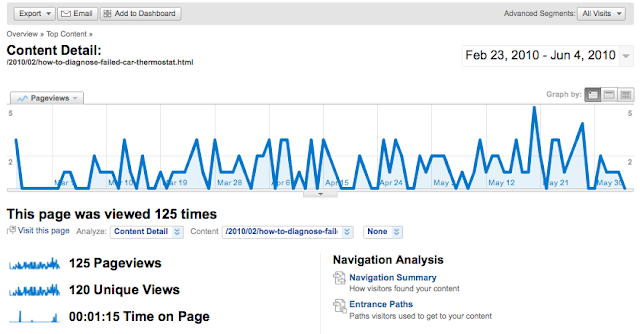
Here's the traffic this post pulled in since it was posted in October. As you can see, it's continued to bring in a steady amount of traffic long after its original post date. Additionally, the bounce rate for this page is well below site average.

business blog traffic stats
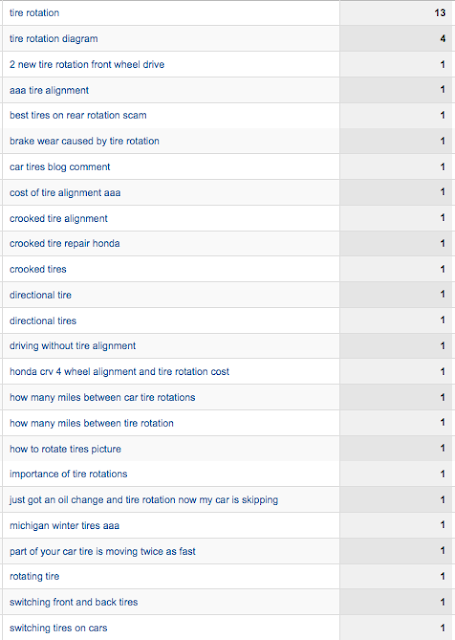
Here's a quick look at the keywords which brought traffic in to this post. This is only a snapshot of the top 25 keywords. As you can see, "tire rotation" may be the most common, but the rest of the longtail keywords combined brought in more traffic than the main keyword, "tire rotation" did alone.

how to use longtail keywords for business blogging

Here's a similar example, based off a "failed thermostat" blog post.

Here's the original post, with targeted keyword phrases circled:

seo business blogging

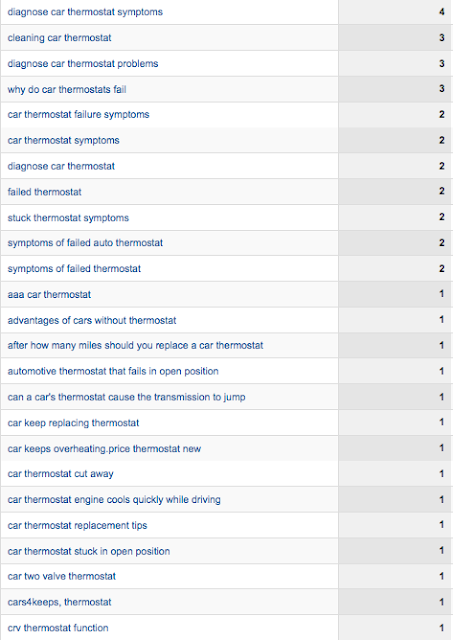
Now, take a look at this post's web stats and the keywords for which it was most frequently found:

search engine optimized blog post stats
longtail keywords

I can understand why longtail keywords make many old school SEO gurus squeamish; they're amorphous, unpredictable, and using them requires a great deal of intuition. When combined with a well-optimized business blog, however, they can be an incredibly effective tool for getting more traffic and, if the business blog is well written, hopefully inbound links as well.

Why are longtail keywords most effective when paired with a business blog? If you'd like to know more about SEO for business blogs, head over to my website's business blogging resource section. Of course, if you're still confused, I'd love to answer your questions personally.

Next week we'll take a look at basic link building strategies.
I thought I'd kick things off with a series on the basics of Search Engine Optimization. SEO is one of the most common - and complex - topics I find myself engaged in with clients, and it makes sense to start out with the "building blocks" of every successful web marketing strategy.

Even if you know nothing about search engine optimization, you've probably heard about how important keywords are. Keywords are absolutely foundational to search engine optimization, and for any successful web marketing campaign, for that matter. SEO experts discuss how and where to use them all the time, but what's seldom discussed is exactly what they are - and how to identify the right ones to use in your campaign.

Without thorough, accurate keyword research, even the best internet marketing campaign will at best be inefficient. At worst, it will hemorrhage time and money.

Let's take a look at the basic principles of keyword research, starting with a definition:

Keyword: a word or short phrase which captures the essence of the topic being discussed in a particular web page or campaign.

Now, this is where it gets tricky.

There's a huge difference between the keywords YOU think apply to your website and the keywords your potential customers are using in search engine queries. If you simply try to guess, you may be right sometimes, but it would be like playing darts in the dark. Plus, you will be guaranteed to be missing out on other major terms you wouldn't have thought of.

Example:

I was recently reviewing the website of an auto repair shop. The page title read:

"Community Car Repair".

Granted, the owner hadn't put
too much thought into the words, but he felt fairly confident he'd chosen a good phrase. I took 30 seconds to plug a few alternative phrases into Google's keyword tool, and this is what we found:

"Community Car Repair" ended up having the lowest search volume, and "Car Repair" has roughly 1/7th the search volume of "Auto Repair". (PS, for now we're only looking at Global Monthly Search Volume. Local Search Volume is usually unreliable, for a number of reasons we won't go into now).

Clearly, "Community Auto Repair" will bring this auto repair shop more traffic than "Community Car Repair".

But wait: there's more. It's not enough to find the one highest volume term for your industry then pepper your entire site with that single phrase. Focusing on a single phrase, or even two or three phrases, will not only make your site look spamalicious to your potential leads, customers and to Google, but it will cause you to miss out on a host of traffic brought in by longer, more diverse phrases.

Search queries composed of long, complex words and phrases are called "longtail keywords", and they're quickly becoming the Holy Grail of SEO. One of my favorite SEO bloggers, Tim Grice, pounds this point home when he emphasizes that 90% of his organic search traffic comes from longtail keywords, rather than short, 2-3 word keyword phrases.

For example, Tim routinely ranks between #1-#5 on page one of Google for the "shorttail" keyword:
seo consultant

Yet the majority of his traffic comes from longer, more complex search queries such as:
search engine marketing consultant in the UK
how to use link building to improve seo
anchor text best practices for on-page search engine optimisation

We'll tackle using longtail keywords in business blogs to boost search engine traffic in a later post, but it's important to understand the concept of them in order to do effective keyword research.

How do longtail keywords effect keyword research?

Being aware that long, complex phrases are just as crucial - if not more so - as regular high volume keywords causes us to be more alert when performing research. Rather than scanning Google's keyword tool for only the highest volume terms, we need to look for common words and phrases which appear across different queries.

When performing keyword research, I typically segregate keywords into a focus group and a content group. Into the focus group, I toss short, high volume keywords which I'll use to optimize the most crucial areas of a website. Into the content group, I'll toss keywords with lower volume which appear commonly across different phrases, including their most common combinations. When writing content, such as web page content or blog posts, I'll string words from the focus group with relevant phrases from the content group into as many different "longtail" keyword combinations as I can fit.

Using this strategy, I not only capture a more diverse pool of keywords in organic searches, but I help the content sound more natural by using more diverse phrases.


Take the above results from Google's keyword tool, for example. If I were optimizing a set of pages for "high heel shoes", I'd want to take into consideration all the color and style qualifiers which are used in the lower-volume search strings. By combining common descriptive qualifiers with my root keyword, "high heel shoes", and peppering my longtail phrases throughout content and titles, I could triple my search traffic.

Confused yet? Shoot me a question!

Next week we'll take a more in-depth look at how to get the most out of Google's keyword tool.