Pages

Showing posts with label keyword research. Show all posts
Recently, an associate of mine passed along a link to a new business website he wanted me to review for SEO. The development, coding and SEO had been contracted to a web development firm in India, and the firm claimed to my associate that the website was 100% search engine optimized.

Which I found very interesting.

To be fair, the site's overall structure and code was clean and very SEO friendly. There was no text hidden in images, URL structures were neat and each page had a defined keyword cloud. H1 and H2 tags were used, and some in-paragraph keyword text was even bolded.

So, why did I feel this site was not properly optimized? One main reason: its keywords were off. Also, its page titles were not properly formatted, but we won't focus on that today.

A recent guest post over at Men with Pens lists common "SEO mistakes that make you look like an amateur", and two out of five of these mistakes are regarding wrong keyword choice. One of the mistakes is "choosing useless keywords" - in other words, keywords that people aren't searching for. The other is "choosing keywords you can't win" - keywords that are simply too competitive for your budget.

Choosing the right keywords for your website is absolutely foundational to your site's success. After all, the keywords you decide to target determine who will find you in search results - and what your visitors will expect from your site. When I talk about your website's success, I'm not talking about traffic volume. You can choose keywords that bring your site plenty of visitors, but ultimately, number visitors aren't what matter most. I'm talking about quality, engagement and conversions. If you're a marketing manager, it's thing your boss is always nagging you about: ROI.

The right keywords will bring your site visitors, yes, but more importantly, they should bring you visitors who are looking to buy the products or services your site is selling. They're not looking for definitions or general information - they're looking for what your site has to offer.

In the web marketing industry, this is called traffic quality.

Let's take a look at a few key factors to keep in mind when choosing keywords.

Overly competitive keywords.

Aka "keywords you can't win" - these are keywords with a monthly search volume that is simply out of your range. When you check for keyword search volume (which you NEED to do for every last keyword), have a target search volume which matches your budget and project scope already in mind. For example, if your website's budget for startup marketing is only $2,000, you don't want to choose keywords with 110,000 monthly searches. It's simply not practical. You don't have the resources to compete for this keyword, but don't worry - you have other options. Try narrowing your keywords to hone in on your site's specialty or niche; find keywords with between 2,000 and 5,000 in monthly search volume, and optimize for those. Once revenue for these niche keywords begins to come in and your site budget expands, you can begin to try for the more competitive terms.

Overly general keywords.

Another reason not to go for terms with the highest volume is that they may not be as specific as they need to be. Think again about traffic quality, and weeding out potential visitors who are only looking for general information, or services your site doesn't offer.

Going back to my associate's website SEO, this was my biggest problem with the keywords. Most of them were very general and, consequently, competitive, and the site simply didn't have the budget to compete for the keywords it was using. Also, its general keywords could be often used to search for information about the service it was marketing, not the services themselves.

Look, for example, at the difference in search volume in the terms below:


"Product design" and "product development" (the terms being used on the site in question) have a very high search volume, close to 300,000 in global searches each. Yet if you google both of these terms, you'll find 1/3 to 1/2 of the first page results are informational. Even if the budget was expanded to effectively market these terms, a large portion of the traffic would be unqualified.

Smaller, more specific terms such as "new product development", "new product design" and "new product development services" would be easier to gain rankings for AND would bring in more qualified traffic.

Keywords with little or no search volume.

On the flip side of the coin, it is possible to optimize your site for keywords that are too specific - or are simply the wrong terminology. Industry professionals have a tendency to use a different terminology than their consumers, and this becomes very evident when it comes to search. Websites which are optimized for the terms industry insiders use to describe the products or services being offered run the risk of getting little or no traffic at all. You may call your sweater a "brushed Montauk cardigan", but I'm probably going to search for a "merino wool cardigan", and unless you've optimized your product page with those descriptors, I'm not going to find your sweater.

Irrelevant keywords.

This concept is obvious enough: your keywords must be 100% relevant to your products, period. A great way to test to make sure the keywords you've chosen represent your products or services is to do a little searching yourself. Search for the terms you want to use, and browse the results. Are your competitors there? Do the results match the contents of your own website? If so, you've found a winner. If the results are unrelated to your product or service, you'll need to refine your terms.

In retrospect, the firm in India my associate contracted may have done the best with what they had to work with based on the terms they were given. This, however, punctuates how important it is for business owners and their SEOs to thoroughly discuss and research keywords before moving forward on a project.

Over at Creative Web Business, we've got a resource section specifically dedicated to helping business owners understand the keyword research process. Just visit us and click through to the resource section.
I tend to talk about longtail keywords a lot, for three main reasons:

1) I've had steady success using them, particularly in the context of business blogging

2) Longtail keywords can make up 50-90% of any given site's organic search volume (not to mention traffic brought in from longtail keywords usually has a higher conversion rate)

3) Writing with longtail keywords is WAY more fun and sounds WAY more natural than trying to use a single term to reach an unnatural keyword density.

Still, when a client grows tired of my marketing lingo and asks me to explain what a longtail keyword is, I inevitably find myself saying, "um..."

In short, longtail keywords are long, complex or unusual search queries. Unlike regular keywords, longtail keywords usually have very low - if any - search volume, since these queries tend to be very unique. Longtail keyword search queries are highly sophisticated searches made by search engine users who know exactly what they're looking for and are trying to weed out generic search results.

For example, as a savvy searcher, I might use the longtail search query "aaa ford focus front end repair grand rapids" rather than simply typing in "auto repair" when searching for an auto repair shop. Using a very specific query like this makes it more likely that I'll find exactly the result I'm looking for. From a marketer's end, this means that users who find a website by using longtail keywords are more likely to convert into a sale or lead.

Although longtail keywords have very low search volume and are very often unique, when you count up all the longtail keywords bringing traffic to any given site, they often outnumber the amount of traffic brought in by regular keywords, such as "auto repair". Optimizing for longtail keywords takes some strong creative thinking skills, but if done well, it can dramatically increase quality traffic.

Rather than discussing longtail keywords abstractly, I'd like to show how I've used them effectively in the context of business blogging. This particular case study will show how blogging using longtail keywords helped boost qualified traffic - and likely gather a few inbound links - for a local auto repair shop.

First, take a look at a blog post I made on tire rotation:


keyword research for business blogs

I initially landed on the topic of tire rotation by doing keyword research on a number of repair services to see which ones were searched the most. I noticed that not only did "tire rotation" related keywords have a fairly high prominence, but it seemed that many people were searching this term in an attempt to find out more information on when, how and where to have their car's tires rotated.

From there, it was downhill. I did a few quick Google searches to see what information was already available on these topics, then I brainstormed a shortlist of phrases based loosely off my initial keyword search. This is where the creative part came in. Rather than picking short, obvious (and highly competitive) terms, I thought about all the various ways users might phrase questions about tire rotation. My shortlist included phrasings like:

when to have my car's tires rotated
front end tire rotation
all wheel tire rotation
routine tire rotation
how often should my tires be rotated
rotate tires every ___ miles

Keeping these phrases at the top of my mind, I continued to write an informative post about optimal tire rotation maintenance, peppering in other related terms, such as "maintenance", "car", "rear tires" and "misalignment".

Phrases which were most important received the most prominence by being placed in the blog post's title and bolded header.

Now, let's look at the results.

Here's the traffic this post pulled in since it was posted in October. As you can see, it's continued to bring in a steady amount of traffic long after its original post date. Additionally, the bounce rate for this page is well below site average.

business blog traffic stats
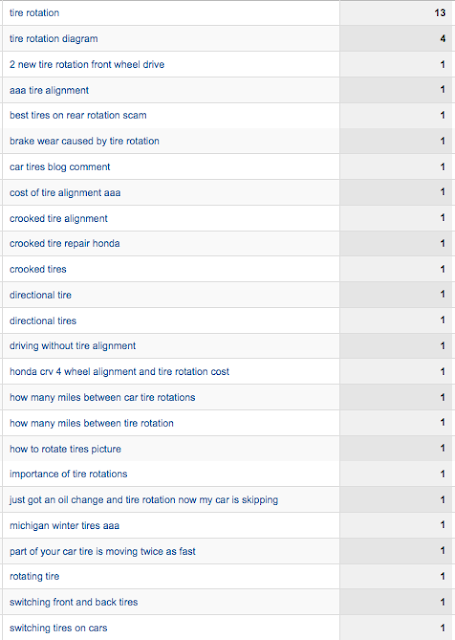
Here's a quick look at the keywords which brought traffic in to this post. This is only a snapshot of the top 25 keywords. As you can see, "tire rotation" may be the most common, but the rest of the longtail keywords combined brought in more traffic than the main keyword, "tire rotation" did alone.

how to use longtail keywords for business blogging

Here's a similar example, based off a "failed thermostat" blog post.

Here's the original post, with targeted keyword phrases circled:

seo business blogging

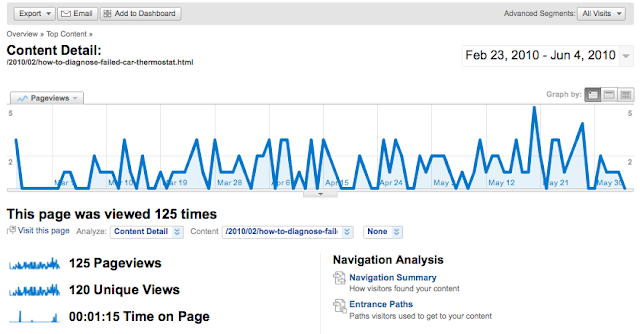
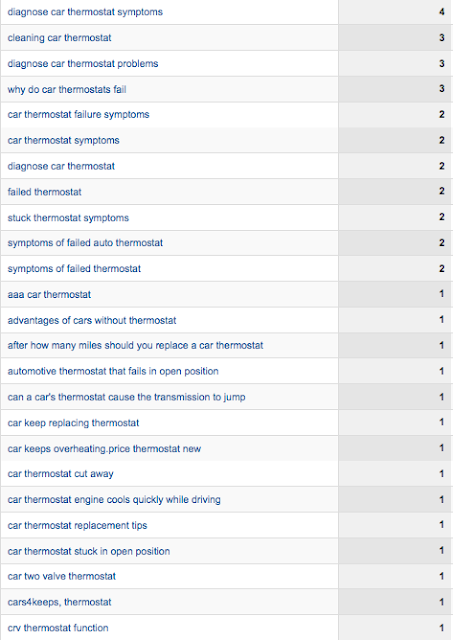
Now, take a look at this post's web stats and the keywords for which it was most frequently found:

search engine optimized blog post stats
longtail keywords

I can understand why longtail keywords make many old school SEO gurus squeamish; they're amorphous, unpredictable, and using them requires a great deal of intuition. When combined with a well-optimized business blog, however, they can be an incredibly effective tool for getting more traffic and, if the business blog is well written, hopefully inbound links as well.

Why are longtail keywords most effective when paired with a business blog? If you'd like to know more about SEO for business blogs, head over to my website's business blogging resource section. Of course, if you're still confused, I'd love to answer your questions personally.

Next week we'll take a look at basic link building strategies.
I thought I'd kick things off with a series on the basics of Search Engine Optimization. SEO is one of the most common - and complex - topics I find myself engaged in with clients, and it makes sense to start out with the "building blocks" of every successful web marketing strategy.

Even if you know nothing about search engine optimization, you've probably heard about how important keywords are. Keywords are absolutely foundational to search engine optimization, and for any successful web marketing campaign, for that matter. SEO experts discuss how and where to use them all the time, but what's seldom discussed is exactly what they are - and how to identify the right ones to use in your campaign.

Without thorough, accurate keyword research, even the best internet marketing campaign will at best be inefficient. At worst, it will hemorrhage time and money.

Let's take a look at the basic principles of keyword research, starting with a definition:

Keyword: a word or short phrase which captures the essence of the topic being discussed in a particular web page or campaign.

Now, this is where it gets tricky.

There's a huge difference between the keywords YOU think apply to your website and the keywords your potential customers are using in search engine queries. If you simply try to guess, you may be right sometimes, but it would be like playing darts in the dark. Plus, you will be guaranteed to be missing out on other major terms you wouldn't have thought of.

Example:

I was recently reviewing the website of an auto repair shop. The page title read:

"Community Car Repair".

Granted, the owner hadn't put
too much thought into the words, but he felt fairly confident he'd chosen a good phrase. I took 30 seconds to plug a few alternative phrases into Google's keyword tool, and this is what we found:

"Community Car Repair" ended up having the lowest search volume, and "Car Repair" has roughly 1/7th the search volume of "Auto Repair". (PS, for now we're only looking at Global Monthly Search Volume. Local Search Volume is usually unreliable, for a number of reasons we won't go into now).

Clearly, "Community Auto Repair" will bring this auto repair shop more traffic than "Community Car Repair".

But wait: there's more. It's not enough to find the one highest volume term for your industry then pepper your entire site with that single phrase. Focusing on a single phrase, or even two or three phrases, will not only make your site look spamalicious to your potential leads, customers and to Google, but it will cause you to miss out on a host of traffic brought in by longer, more diverse phrases.

Search queries composed of long, complex words and phrases are called "longtail keywords", and they're quickly becoming the Holy Grail of SEO. One of my favorite SEO bloggers, Tim Grice, pounds this point home when he emphasizes that 90% of his organic search traffic comes from longtail keywords, rather than short, 2-3 word keyword phrases.

For example, Tim routinely ranks between #1-#5 on page one of Google for the "shorttail" keyword:
seo consultant

Yet the majority of his traffic comes from longer, more complex search queries such as:
search engine marketing consultant in the UK
how to use link building to improve seo
anchor text best practices for on-page search engine optimisation

We'll tackle using longtail keywords in business blogs to boost search engine traffic in a later post, but it's important to understand the concept of them in order to do effective keyword research.

How do longtail keywords effect keyword research?

Being aware that long, complex phrases are just as crucial - if not more so - as regular high volume keywords causes us to be more alert when performing research. Rather than scanning Google's keyword tool for only the highest volume terms, we need to look for common words and phrases which appear across different queries.

When performing keyword research, I typically segregate keywords into a focus group and a content group. Into the focus group, I toss short, high volume keywords which I'll use to optimize the most crucial areas of a website. Into the content group, I'll toss keywords with lower volume which appear commonly across different phrases, including their most common combinations. When writing content, such as web page content or blog posts, I'll string words from the focus group with relevant phrases from the content group into as many different "longtail" keyword combinations as I can fit.

Using this strategy, I not only capture a more diverse pool of keywords in organic searches, but I help the content sound more natural by using more diverse phrases.


Take the above results from Google's keyword tool, for example. If I were optimizing a set of pages for "high heel shoes", I'd want to take into consideration all the color and style qualifiers which are used in the lower-volume search strings. By combining common descriptive qualifiers with my root keyword, "high heel shoes", and peppering my longtail phrases throughout content and titles, I could triple my search traffic.

Confused yet? Shoot me a question!

Next week we'll take a more in-depth look at how to get the most out of Google's keyword tool.